Find out how much is your startup worth? Let’s be honest.
You probably didn’t start your company because you love cap tables, liquidation prefs, or 5-tab spreadsheets.
But here we are.
Sooner or later, every founder runs into the same question:
“How much is my startup worth?”
And the answer?
So instead of fumbling in the dark or slinging a number you found on Reddit...
And yeah, I’ve made sure it’s 2025-ready.
🧠 What’s Inside: 0. TL;DR - Get your number fast I. The Basics - How startup valuation really works II. 5-Step Formula to Find Your Valuation III. 7 Benchmarks To Keep Your Number Realistic IV. 9 Advanced Methods for the Nerds (or Series A+)
🔓 Want all 9 valuation methods? Become a Premium subscriber and get all the tools, decks, and templates I’d kill to have when I was raising.
🦄 40 pitch decks that built Unicorns The Ultimate Investors List of Lists The Only Finance Tracker Your Startup Needs The Ultimate Notion Data Room (all key docs you’ll EVER need)The Most Successful Investor Update Template SAFE Note Dilution Calculator & Cap Table Builder Co-Founder Agreement Templates + Legal Clauses You Can't Forget
Scorecard Method – Value vs market average + score based on team, traction0. TL;DR If you’re in a rush, two cheat sheets:
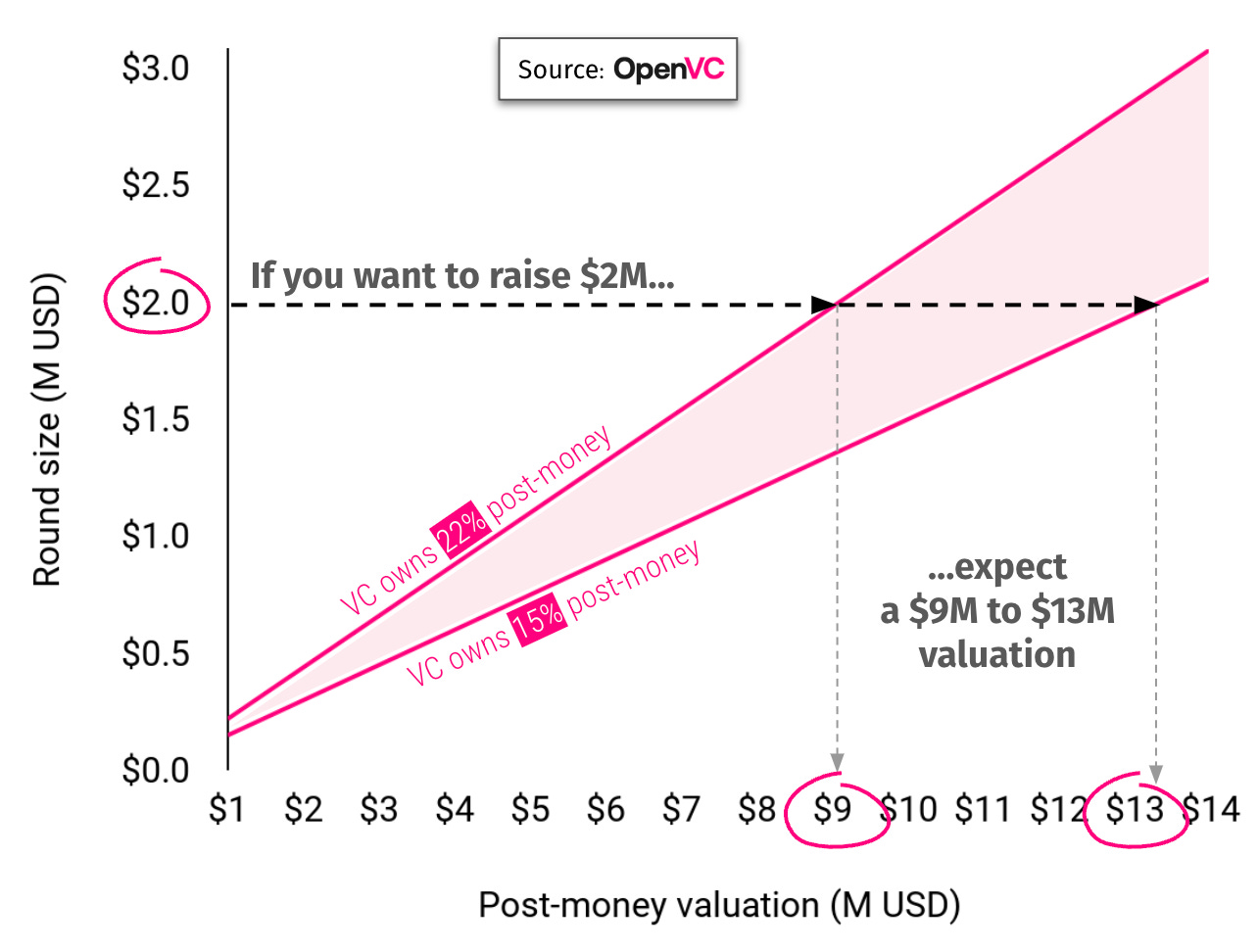
💸 Valuation = Round size / Target dilution Raise for 18 months. Hit the metrics. Avoid down rounds.
Still here? Good. Let’s unpack it.
I. The Basics: Valuation Isn’t What You Think Here’s the brutal truth:whatever a sane investor agrees to pay for it.
That’s it.
Founders get caught up trying to argue they’re worth $20M because of TAM slides and “market momentum.”
Don’t do that.
Valuation is a means to an end , not your scoreboard.not raising at all.
II. How to Find Your Valuation in 5 Steps 1. Know how much you need Figure out how much you’ll burn in the next 18 months.
2. Work backwards Investors usually want 15-25% equity at early stage.post-money valuation = $2M / 20% = $10M .
3. Pre-money = Post-money - Round size So in that example, your pre-money = $8M.
Always specify “$8M pre” or “$10M post” when negotiating.
4. Reality check: What’s left for you? After the raise, founders should own:
✅ 70%+ post-seed ✅ 50%+ post-Series A Anything less = broken cap table.
5. Compare to the market Before you pitch VCs, do your homework.
That’s where the benchmark vault below comes in.
III. 7 Valuation Benchmarks You Can Steal Here is the best data from across the startup world:
🧵 [Carta Q4 2024 ]: Median pre-money valuations by stage
📊 [AngelList 2024 ]: Median Valuation $10M for pre-seed, $20M for seed
Pitchbook ]: US & EU startup valuations, stage by stage
🇫🇷 [Avolta ]: France-specific VC & exit multiples
📉 [Ihar Mahaniok ]: Seed-stage SaaS in NYC/SF
📈 [Lenny Rachitsky ]: Retention metrics for SaaS, social, ecomm
🧪 [OpenView ]: Deep SaaS benchmarks for burn, CAC, growth
💡 [Initialized ]: What it takes to raise Series A in SaaS, DTC
IV. Advanced Valuation Methods (For Nerds + Later Stage) Want to impress your CFO or curious investor?
📚 The 9 frameworks:
Berkus Method – Estimate value based on “ingredients” (tech, team, etc.)Risk Factor Summation – Adjust for 12 startup risk categoriesComparable Transactions – Benchmark against similar dealsBook Value – Based on hard assets (mostly useless for early-stage)Liquidation Value – Worst-case fire-sale mathDiscounted Cash Flow (DCF) – Projected future revenue (for later-stage)First Chicago Method – Weighted scenario analysisVC Method – Reverse engineer from exit size & return expectationsNot all of these are relevant for pre-seed or seed founders.
Final Thought Valuation is part math.
The worst founders obsess over price.getting the right partners around the table , even if that means raising at a slightly lower number.
You don’t win by owning more of the pie.much, much bigger pie.
So bake it.
Found this helpful, make sure to share with other fellow founders.
👉 Subscribe to my Newsletter